Designing lean provocations
Small, low-effort design moves that make false organisational stories wobble, based on my ExConf 2017 talk and expanded into a deeper essay.
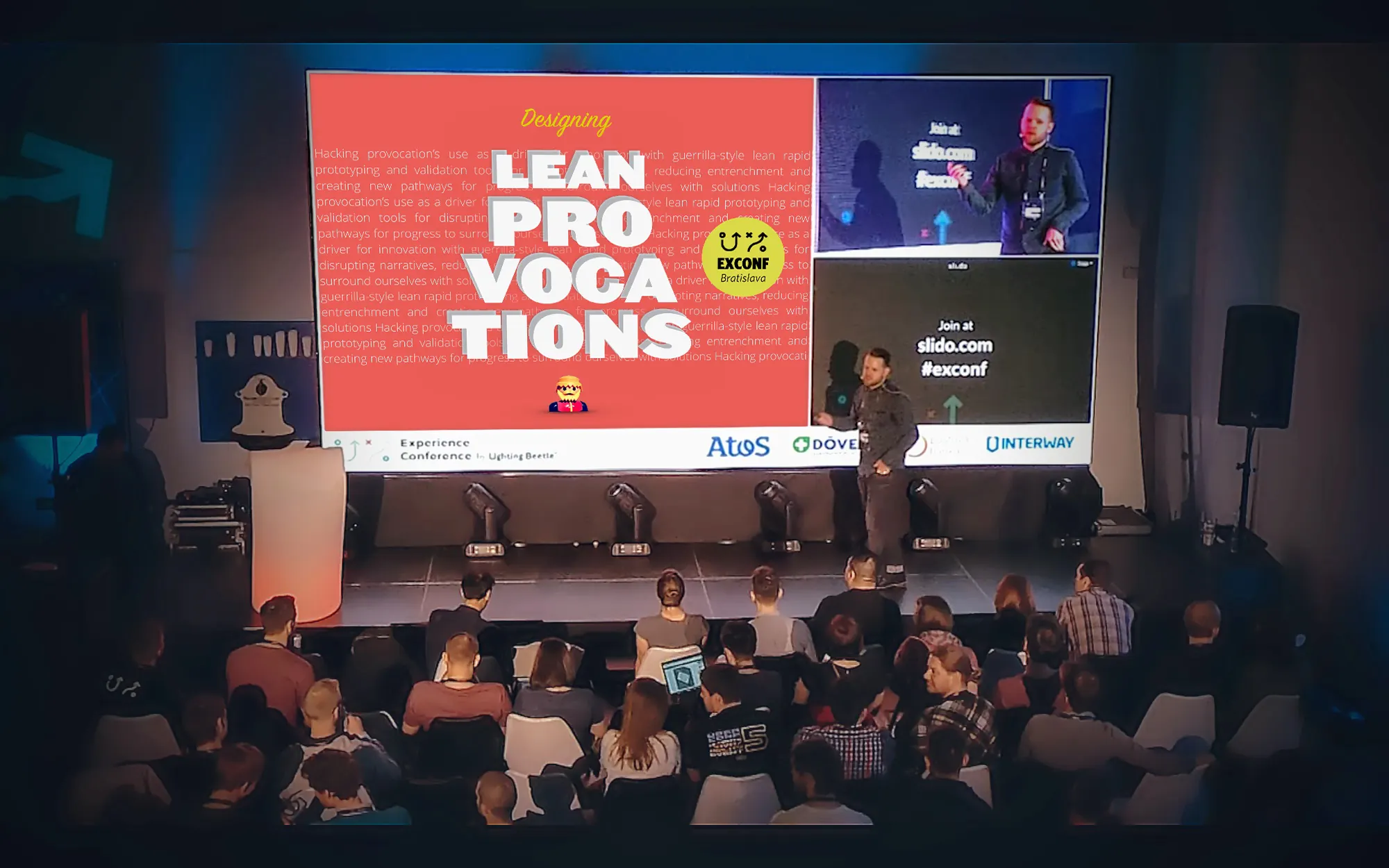
From my talk at ExConf 2017, UX Bratislava in Slovakia.
Background
ExConf 2017 (Experience Conference) was a two-day, international UX and digital innovation event held on 9–10 March 2017 at the Waterworks Museum in Bratislava, bringing together designers, researchers, and strategists from across the globe to share work and shape user-centred practice.
This is both a transcript and an expansion: the talk itself, followed by a structured tool overview, and then a deeper dive into theory and connections. I’ve kept the spirit of the live talk intact — examples, asides, even the Q&A echoes — but added grounding in systems thinking, behavioural science, and strategy.
Part 1: The Talk
Designing for Lean Provocations
What if the biggest barrier to innovation isn’t money, talent, or time — but the stories we tell ourselves?
Stories that sound like truth but act like walls:
“We already know our users.”
“Risk isn’t tolerated here.”
“That’s not how things get approved.”
Lean provocations are a way to break those walls open. Small, minimal-effort design moves that provoke a real reaction. Not to create chaos. Not to win an argument. To destabilise a false story just enough that something new can enter.
My original talk
When I first spoke about lean provocations, I realised there was no established definition — because I made the term up.
The subtitle I chose was intentionally provocative: “Hacking provocations as a driver for innovation with guerrilla-style lean rapid-prototyping and validation tools for disrupting narratives, reducing entrenchment and creating new pathways for progress.”
It sounds like a mouthful because the topic itself is still evolving. I was learning how to communicate it, and I told the audience I hoped they would help me refine it.
To set the stage, I asked people to loosen up: raise your hand, get ready to participate.
I explained how I came to this point: through UX design, frontend development, and even an art degree. For the past seven years I’ve been obsessed with how we solve problems — not just in UX, but in business more broadly.
I often visualise our work through a simple model: the problem space and the solution space. Each has divergent phases — searching widely — and convergent phases — narrowing down. These cycles play out in all kinds of contexts: agile, lean, Kanban, corporate, domestic. Whatever the frame, the rhythm is the same: diverge to explore, converge to focus.
The problem space: constraints and narratives
I built on ideas the audience had already heard that day. What I was offering didn’t replace value-driven design, cross-disciplinary collaboration, or user research. Those remain essential. Lean provocations were an additional tool.
The problems many of us face look like this:
Teams lack authority
In large organisations, “skunk works” groups historically reported directly to executives. Most of us don’t have that privilege. We’re expected to innovate without being empowered to make decisions quickly.
Companies fall out of relevance
A colleague once noted how simply bringing customers into meetings could provoke executives, because they so rarely interacted with them.
There’s no time for experimentation
Risk and failure are unacceptable. Even when teams are told they can experiment, the space is tightly constrained by deadlines and budget.
We’re often told to build a logical business case to persuade managers. That’s sensible, but slow. Your project might be over before the organisation’s mindset shifts. Sometimes you need a quicker intervention.
We admire examples like Airbnb — small, nurtured ideas that grew through continuous user conversations.
As designers we see ourselves as advocates for the user, producing ideas that improve experiences. Yet it often feels like everyone else is trying to kill those ideas. There’s no mastermind suppressing innovation; colleagues are focused on delivery, optimisation, and management.
Constraints are real and deserve respect — but they shouldn’t rule us.
We also work within complex adaptive systems: networks of people, rules, and feedback loops. Within these systems, narratives — the stories told about products, users, and organisations — hold immense power.
I once met a very senior technical researcher at Citrix who despite needing help to understand users, dismissed a UX colleague because he didn’t “need design.” He simply didn’t understand her role. That narrative alone shaped decisions and blocked collaboration. That colleague wasn’t just anyone, they now lead research at a bank valued over 4 trillion dollars.
We have excellent tools for understanding problems — personas, journey maps, scenarios. But we have fewer tools for exploring solutions. Too often we drape ourselves in the problem and forget to clothe ourselves in the solution.
Defining provocation
To address the gap in our tools, we need to talk about provocation.
Here are three possible definitions:
- To deliberately anger someone.
- To arouse sexual desire.
- To test in order to elicit a reaction.
At first they seem disconnected. But they all point to primitive responses — anger, desire, reflex — rooted in the limbic system.
Information flows through that “gator brain” before reaching higher cognition. That’s why provocations grab attention.
And that’s why they matter in design. We can use them ethically: artefacts that speak to the limbic system, provoking curiosity, discomfort, or discussion.
Done carelessly, provocation is trolling.
Done thoughtfully, it’s a design move.
Lean provocations within design thinking
So how does this fit with design thinking?
Design thinking packages what designers have always done — observation, prototyping, iteration — into a process that MBAs and managers can grasp. It’s useful, but it can blur a crucial distinction: divergence and convergence.
Without that separation, iteration just circles the same idea. You can iterate a poster of a man’s hairy legs a hundred times and still not reach a new concept.
What we need is conceptual variation: deliberately generating multiple, varied ideas. That’s where provocation comes in.
Clients often resist this because they fear the cost. But imagine if investors required 100 conceptual variations before funding a start-up. Unrealistic, yes. But as a provocation, it reveals how little variation we usually allow ourselves.
Lean Startup and the scientific method are brilliant for testing hypotheses. But they don’t teach us how to generate radically different hypotheses in the first place.
That’s where lean provocations work: minimal-effort design activities meant to elicit a reaction, change narratives, and catalyse learning. They let us test assumptions quickly while also producing variation.
Examples of provocations from outside UX
Marcel Duchamp’s Fountain (1917)
In 1917, Marcel Duchamp submitted a porcelain urinal to the Society of Independent Artists, signing it “R. Mutt.” The rules said any work would be accepted if the fee was paid. No jury, no gatekeepers. Duchamp paid, signed, and submitted. He didn’t sculpt or paint. He selected, titled, and placed. A porcelain urinal became Fountain.
The provocation was simple: not about craft, but about context. Take a mass-produced object, rename it, put it inside an art institution, and ask the institution to live with its own promise. It was pure provocation — what if a urinal is art? Not forever, but long enough to see what followed.
The reaction was chaos. Committees argued. The piece was hidden, then rejected, even though the rules said “accept everything.” Duchamp resigned from the committee in protest. Critics debated. Stieglitz photographed it. The Blind Man defended it. The original was lost, but the argument never ended. A crack opened: before Fountain, art equalled craft, skill, originality. After it, art could equal concept, context, decision. Duchamp didn’t persuade with a lecture. He forced a decision with an artefact.
Why it’s a lean provocation
- Minimal effort. Bought, signed, submitted. No craft, just reframing.
- Maximal reaction. Outrage, debate, resignation, decades of discourse.
- Narrative shift. From art as craft to art as concept.
- Enduring impact. Modern and contemporary art still orbit Fountain.
Lessons
- Expose contradictions inside the system — that’s where provocations bite.
- Placement matters more than polish.
- Reframing the familiar can disrupt harder than inventing the new.
- The strongest provocations make the old story impossible to keep telling.
Zürich Bauprofile
In Zürich and other parts of Switzerland and Germany, thin poles sometimes rise from empty lots, strung with netting that sketches the outline of a ghost building. These aren’t art installations but Bauprofile — building profile markers that show the planned height and volume of future construction. Minimal structure, maximal impact.
Developers are required to erect Bauprofile before approval. The aim is simple: make the future visible. Previously, neighbours had to decipher blueprints or sift through planning documents online, and most didn’t bother. With Bauprofile, the outline of the new building is written directly into the skyline. Lightweight poles and wires turn abstraction into lived experience: this is how tall it will be, this is how much light it will block, this is the shape of your future.
The reaction is immediate. Outrage, petitions, debates — or sometimes relief, when the reality is less intrusive than feared. What had been hidden in planning jargon becomes embodied in daily space. Before Bauprofile, the story was that planning documents were enough. With them, a new story emerged: until you see the impact in place, the plan isn’t real.
Why it’s a lean provocation
- Minimal effort: poles, wires, netting. Reusable and low-cost.
- Clarity at a glance: anyone walking by can understand.
- Targeted: challenges the belief that documents are sufficient.
- Placed for effect: right in the neighbourhood, in daily sight.
- Maximal reaction: citizens engage early, sometimes fiercely.
Lessons
- Make the invisible visible. Provocations cut through abstraction by showing consequences directly.
- Presence over polish. The placement matters more than the craft.
- Embodiment transforms participation. Ghost buildings turn passive neighbours into active stakeholders.
SpotCo and La Cage aux Folles Posters
For the Broadway revival of La Cage aux Folles, SpotCo didn’t bring a handful of sketches. They built out a wall of radically different posters — fully realised concepts, not just variations on a theme. Moustache and lipstick mash-ups. Neon illustrations. Bold typography. Each one felt like a complete story.
The producer pinned them up and asked: “Do I want to live with this for the rest of my life?” The exercise forced them beyond surface preference into existential choice. A poster wasn’t just marketing collateral. It was the identity of the show, the story they would carry for years. Iterating one idea could never have done that. The provocation was in the spread — seeing incompatible futures side by side.
Before this exercise, the story was: a poster is marketing collateral, chosen for appeal. After, the story shifted: a poster is identity, a mirror of the values the production wants to inhabit. SpotCo used variation not to please but to provoke, reframing the act of choosing as an act of commitment.
And here’s the sting: SpotCo invested real time and craft to create those provocations. You rarely see that in digital. Imagine prototyping three different service models at full scale, or building three working apps to test interaction patterns. We say it’s too complex, too expensive. But is that a good excuse when the outcomes can be measured in billions of dollars, or people’s lives? Broadway posters prove a point we often duck: sometimes the work of provocation requires depth, not just speed.
Why it’s a lean provocation
- Not minimal in craft, but minimal compared to the cost of getting it wrong.
- Maximal reaction: provoked existential reflection about identity, not just taste.
- Targeted: shattered the story that “charming is enough.”
- Placed for effect: a wall of futures the client could not unsee.
Lessons
- Variation at depth can be the strongest provocation.
- Investing in multiple futures is cheaper than betting everything on one.
- In digital, “too complex” or “time wasted” is often just a narrative of avoidance.
From incremental to conceptual innovation
Edward de Bono argued that the harmful ideas aren’t usually new ones, but old ones stretched too far.
Supersonic jets and pollution are just extensions of old logics: go faster, throw it away. Nuclear weapons: make your weapons stronger.
Businesses need new ideas. But most design practices — user-centred design, lean startup — excel at incremental innovation. They refine, they optimise. Rarely do they produce conceptual leaps.
IBM’s design thinking model, for instance, compresses divergence and convergence into one continuous process. That blurring kills conceptual variation. Making and iterating is important, but it won’t get you from one idea to a fundamentally different one.
Lean Startup is brilliant at testing hypotheses. But the scientific method doesn’t generate new hypotheses — it only evaluates them.
We need methods that deliberately produce conceptual variation. That’s where lean provocations combine with lean techniques to open new pathways.
Edward de Bono and provocative order
De Bono’s answer was PO provocative operation.
PO is a sideways move in thinking. Not yes or no. Not “I don’t know.” But a deliberate shift: PO: let’s assume this is true for a moment, and see where it takes us.
He described several moves that make PO work:
- The intermediate impossible. Try an obviously wrong idea, not to ship it, but to see what angle it reveals.
- Random juxtaposition. Combine two unrelated things and watch what sparks.
- Challenge for change. Take an assumption and say: what if it didn’t have to be that way?
PO is not about correctness. It’s about loosening the grip of concept prisons — the assumptions we defend unconsciously.
Lean provocations are POs made real in organisations. A quick artefact, a small act, that says: PO: what if it did? Not polished. Not the final answer. Just enough to make a stuck story wobble so a new one can surface.
My own provocations in practice
Interviewing a user against all odds — and as provocation
Our team believed we already understood users — we’d bought expensive research. I pushed to interview an actual user by Monday. Management said it was impossible. I did it anyway. One conversation changed the entire narrative about user research.
Innovation day storyboard
During an “innovation day,” most teams worked on maintenance tasks. An engineer and I spent 30 minutes brainstorming, then explored a new mobile technology. In six hours we had storyboards, artwork, and a speculative demo video. Developers dismissed it as unrealistic. But it challenged assumptions and forced leadership to think about future possibilities.
A sprint without direction
On another project we had budget and time but no shared understanding of what to build. We ran a design sprint, not to validate a solution, but to design a feature we weren’t sure about. That sprint redirected six months of work.
Each of these provocations was quick, low-cost, and deliberately designed to shift a story. None were polished. But all changed the trajectory.
A simple loop
Think of lean provocations as a loop, not a ladder:
- Name the narrative. Write it in one sentence.
- Design the provocation. Pick the smallest artefact that makes that story wobble.
- Run it and watch. Pay attention to reactions, silences, shifts.
- Reflect and iterate. Amplify what moved. Adjust what didn’t.
Traps to avoid
A few traps show up often:
- The lecture trap. Don’t build a deck to tell people they’re wrong. Make an artefact that lets them see it themselves.
- The shock-for-shock’s-sake trap. Big noise, no learning. Always design in a measure of what would count as a real shift.
- The overbuild trap. Spending weeks. Keep provocations to hours. Split them down if they’re bigger.
- The orphan trap. Running one, then moving on. Plan the follow-up conversation before you begin.
Q&A echoes
When I first gave this talk, the questions I got were telling:
- Isn’t trolling a form of provocation?
- When should developers be involved?
- Are “solutions looking for problems” valid?
- When do you walk away from a tough project?
The surface questions were about practice. But underneath they were about ethics, power, legitimacy, perseverance.
Closing
We already have strong tools for naming problems. What we need now are tools that shake loose solutions when the stories around us have calcified.
Lean provocations are not stunts. They’re respectful jolts: small, fast artefacts that make a big narrative wobble. Duchamp’s urinal. Zürich’s skyline poles. A wall of impossible posters. None solved the whole problem. Each cracked a frame open so new work could begin.
That’s our task too. To stop draping ourselves only in the problem and start clothing ourselves in possible answers. To treat stories as prototypes — testable, fallible, open to redesign.
So ask yourself: what’s one false story in your organisation, and what’s the smallest provocation that could make it wobble?
A way of saying: we could keep telling the same story or we could test a new one right now.
That’s the work.
Broader themes and connections
When routine design fails
Working in UX and strategy often leaves me frustrated. Design teams are given responsibility for innovation but lack the authority or resources to drive change. We’re asked to solve problems we can’t define, or expected to create breakthroughs while being treated as a cost centre.
As I said in my talk: many organisations behave like complex adaptive systems. Multiple narratives, power structures, and hidden assumptions dictate what’s possible. We spend time mapping user needs through personas, but the tools for exploring solutions are thin. Ideas die at the hands of entrenched narratives or the fear of stepping away from the comfortable status quo.
Designers rarely have ways to provoke change deliberately.
I want to use the talk as a starting point and push the idea further: why do small provocations work, when do they fail, and what do they have to do with systems, behaviour and power?
The stakes are not abstract. Organisations fail when their stories become more convincing than reality.
Why we need provocations
Navigating the problem–solution gap
Design processes usually start with empathy and problem definition, but they rarely equip us to explore radical solutions.
Peter Senge’s idea of creative tension explains why this matters. The gap between vision and current reality is what generates creative energy. In theory, that tension pulls reality toward aspiration. In practice, organisations lower their vision to avoid discomfort. Without provocations to stretch the imagination, the tension dissolves and innovation stalls.
Cognitive dissonance
Psychologist Leon Festinger described it as the stress of holding contradictory beliefs. Most people relieve it by retreating to comfort. Lean provocations use dissonance constructively: artefacts that make the falsehood of a narrative visible so people are forced to update their model.
False narratives and the cost of complacency
The danger of ignoring narratives is written into recent history.
The 2008 financial crisis
Economists clung to the efficient-market hypothesis. Critics like Raghuram Rajan were dismissed. Groupthink blinded experts to systemic risk. The result: collapse.
Nokia’s decline
Nokia wasn’t simply killed by Apple and Google. Internal complacency did the job. Focus on short-term performance. Failure to invest in operating systems. Endless reorganisations that drained resources from real innovation.
Different domains, same failure pattern: the organisation keeps telling a comforting story until reality interrupts. Lean provocations exist to destabilise those stories before reality has to do it for us.
Where this connects
I do not think lean provocations are a grand unified theory. They sit in a family of ideas that all, in different ways, ask the same question: how do you move when the existing frame is too small?
Blue Ocean Strategy
Break free from zero-sum “red ocean” competition. Create new market space. Lean provocations help teams see blue oceans: speculative artefacts that surface unmet needs, open demand, and force questions spreadsheets can’t.
Effectuation
Entrepreneurs act with the means at hand, letting goals emerge through interaction. Provocations embody this: cardboard prototypes, scrappy PowerPoint demos, made with whatever is around. Not perfect. But enough to discover new directions.
Frugal innovation / Jugaad
Constraints as catalysts. Clay refrigerators. Bicycle phone chargers. Doing more with less. Lean provocations live here: rough artefacts proving that progress doesn’t need permission or budget.
Nudge theory
Small shifts in environment guide behaviour. Default options. Healthy food at eye level. Lean provocations act as nudges for cognition: reframe the choice set, provoke reconsideration, without forcing outcomes.
Complexity leadership
Innovation emerges from interactions across the system, not top-down control. Provocations create sites of emergence. Rough artefacts pull people from silos, invite exchange, and spark novelty.
Psychological safety
Amy Edmondson calls it “a climate where colleagues feel safe to take interpersonal risks.” Without it, provocations backfire: people stay silent or lash out. With it, provocations generate candour, dissent, and learning.
Speculative design / design fiction
Futures imagined to provoke discussion. Fake ads, headlines, objects from tomorrow. Lean provocations borrow the tactic, but place it inside projects: designed not just to critique, but to shift near-term decisions.
Adaptive leadership
Heifetz and colleagues distinguish technical challenges (clear solutions) from adaptive challenges (messy, uncertain, emotional). Provocations are tools for adaptive challenges. They reveal what’s at stake, stir emotions, and force new thinking.
Guidelines for designing provocations
- Identify the false narrative. Write it down. Target it directly.
- Keep it minimal. Rough and ambiguous works best — it invites projection.
- Aim for the limbic system. Choose formats that touch emotion. Props beat slides.
- Facilitate dialogue, not performance. The provocation isn’t pass/fail. It’s a starter for reflection.
- Iterate and build momentum. Each provocation seeds the next. Small interventions add up.
- Protect psychological safety. Leaders must model humility, admit mistakes, and welcome dissent.
- Document and share. Capture quotes, photos, reactions. Share them widely to shift collective narrative.
Integration with other frameworks
| Framework or principle | How lean provocations complement it | Key takeaway |
|---|---|---|
| Creative tension (Senge) | Provocations create tangible artefacts representing the vision, allowing teams to experience the gap between current reality and desired future. | Maintain the tension without lowering aspirations. |
| Blue Ocean Strategy | Provocations help imagine new market spaces by making alternative offerings tangible; they encourage exploring uncontested territories. | Use provocations to generate “blue ocean” ideas. |
| Effectuation | By using available resources, for example cardboard, paper, or simple scripts, provocations embody effectual reasoning. | Start with what you have; let new goals emerge. |
| Frugal Innovation | Provocations embrace constraint; they prove that innovation can occur without heavy investment. | Scarcity is a spur, not a barrier. |
| Nudge Theory | Provocations nudge stakeholders towards new perspectives through subtle changes in environment or narratives. | Design experiences that guide rather than force. |
| Complexity Leadership | Provocations create sites for emergent interactions across silos, fostering bottom-up innovation. | Foster interactions and resist top-down control. |
| Psychological Safety | Provocations require a climate where people feel safe to disagree and explore. | Build trust before provoking. |
| Speculative Design | Provocations borrow from speculative design by crafting artefacts from possible futures to stimulate debate. | Use future narratives to challenge present assumptions. |
| Adaptive Leadership | Provocations reveal whether a challenge is technical or adaptive and encourage experimentation. | Lead by learning and adjusting. |
Avoiding misuse
Provocations can misfire. Safeguards matter:
- Transparency of intent. Say up front: this is to explore, not to embarrass.
- Consent and respect. No “gotchas.” Don’t spring shock on unsuspecting users.
- Responsibility for impact. Strong emotions need closure. Leave time to debrief.
- Cultural sensitivity. What provokes in one culture may offend in another.
The case for lean provocations in organisations
Big organisations get stuck. Meetings circle the same arguments for years because the dominant stories never get cracked open. Research on provotyping names this: provocations are good at surfacing tensions in design research, but less effective at making organisations actually empathise with the field. In other words, they reveal the problem but don’t always change the way decisions get made.
Why do they stall? A few reasons show up again and again:
- Risk-aversion and culture. Provocations are uncomfortable by design. In a culture allergic to risk — and without psychological safety or senior cover — teams simply avoid them.
- No process hook. A provocation might spark a conversation, but without a follow-up loop — retros, decision forums, leadership review — the system snaps back to the old story.
- Perceived cost vs. benefit. Even low-fidelity provocations take time and expose assumptions. If leaders don’t see quick ROI, they retreat to safer debates.
And that’s why lean provocations matter. Packaging them as low-effort, safe-to-try, and looped into existing cycles lowers the barrier. A quick storyboard, a mock headline, a guerrilla interview — small artefacts that inject fresh evidence into a stagnant conversation without demanding months of research or millions in budget.
The research backs it up: provocations “interrupt, challenge, and even transgress” the usual flow, creating insights that would otherwise never appear. Case studies show that when teams frame their work as “small provocations, a starting point,” they shift narratives and open space for new partnerships.
Lean provocations make this repeatable. They turn abstract debate into something tangible, surface hidden assumptions, and build momentum for change. They’re a practical way to insert new evidence into conversations that would otherwise circle forever.
Conclusion: a new tool for navigating complexity
Most organisations do not lack information. They lack moments where information becomes impossible to ignore.
They are not about being provocative for its own sake. They create a moment where people cannot simply repeat the old explanation and move on. At their best, they expose the fault lines in a story without turning the room into a fight.
They turn abstract visions into tangible experiences, aligning with creative tension and avoiding the complacency that doomed Nokia and blinded the financial sector.
I would not claim lean provocations replace any of these traditions. They are more like a practical bridge: a way to make those ideas felt in a room, in a meeting, in a decision that is otherwise stuck.
As Edward de Bono argued, it’s not new ideas that are dangerous, but old ideas that trap us. Lean provocations offer a way out of these concept prisons.
Most change starts smaller than people want to admit: a sketch, a conversation, a fake poster, a user in the room, a future made visible before anyone has approved it.
References
Books and theories
- De Bono, Edward. PO: A Device for Successful Thinking. Penguin, 1971.
- Senge, Peter. The Fifth Discipline: The Art of the Learning Organization. Doubleday, 1990.
- Festinger, Leon. A Theory of Cognitive Dissonance. Stanford University Press, 1957.
- Kim, W. Chan, and Mauborgne, Renée. Blue Ocean Strategy: How to Create Uncontested Market Space and Make the Competition Irrelevant. Harvard Business Review Press, 2005.
- Sarasvathy, Saras. Effectuation: Elements of Entrepreneurial Expertise. Edward Elgar, 2008.
- Thaler, Richard H., and Sunstein, Cass R. Nudge: Improving Decisions About Health, Wealth, and Happiness. Yale University Press, 2008.
- Heifetz, Ronald, Grashow, Alexander, and Linsky, Marty. The Practice of Adaptive Leadership: Tools and Tactics for Changing Your Organization and the World. Harvard Business Review Press, 2009.
- Edmondson, Amy. The Fearless Organization: Creating Psychological Safety in the Workplace for Learning, Innovation, and Growth. Wiley, 2018.
Articles and analyses
- Lowy Institute. “Groupthink and the Global Financial Crisis.”
- INSEAD Knowledge. “The Real Reason Nokia Lost Its Way.”
- Prosci. “What Is Nudge Theory?.”
- Structural Learning. “Adaptive Leadership Explained.”
- Critical Design. “Speculative and Critical Design Practice.”
- CKJU.net. “Complexity Leadership Theory.”
- Harvard Business School Online. “Psychological Safety and the Workplace.”
- TED Ideas. “Jugaad Innovation: Doing More with Less.”
- Interaction Design Foundation. “Effectuation Theory.”
- Blue Ocean Strategy official site.
- The Systems Thinker. “Creative Tension.”
- ACC NCR Leadership Academy. “Creative Tension as a Leadership Tool.”
Case examples and precedents
- Duchamp, Marcel. Fountain, 1917. Replica, Philadelphia Museum of Art.
- Zürich Building Profile Markers, or Bauprofile. City of Zürich planning practice.
- SpotCo Design Agency. Poster campaign for La Cage aux Folles, Broadway, 2004.
- Airbnb. Founding story and iterative design practices, 2007–2009.
- Tesco. Customer involvement as organisational provocation, case examples shared in UX talks.
- Citrix anecdote, author’s personal experience.
Sources for “The Case for Lean Provocations in Organizations”
- Boer, Laurens, and Mette Agger Eriksen. “Provotyping: Making Sense of the Future in Design Research.” Design Issues, Vol. 32, No. 1, 2016.
- ResearchGate summary: “Provotyping: Exploring Provocations as a Method in Design Research.”
- EPIC People. “Small Provocations: How Lightweight Design Artefacts Shift Organizational Narratives.” EPIC Proceedings, 2018.